AL-MARS
Alobour, Saudi Arabia, 2019
Curated by Dr Effat Fadag
Commissioned by The Saudi Art Council, in dialogue with Prof. Manfred Hild and Simon Untergasser, Neurorobotics Research Laboratory, Berlin
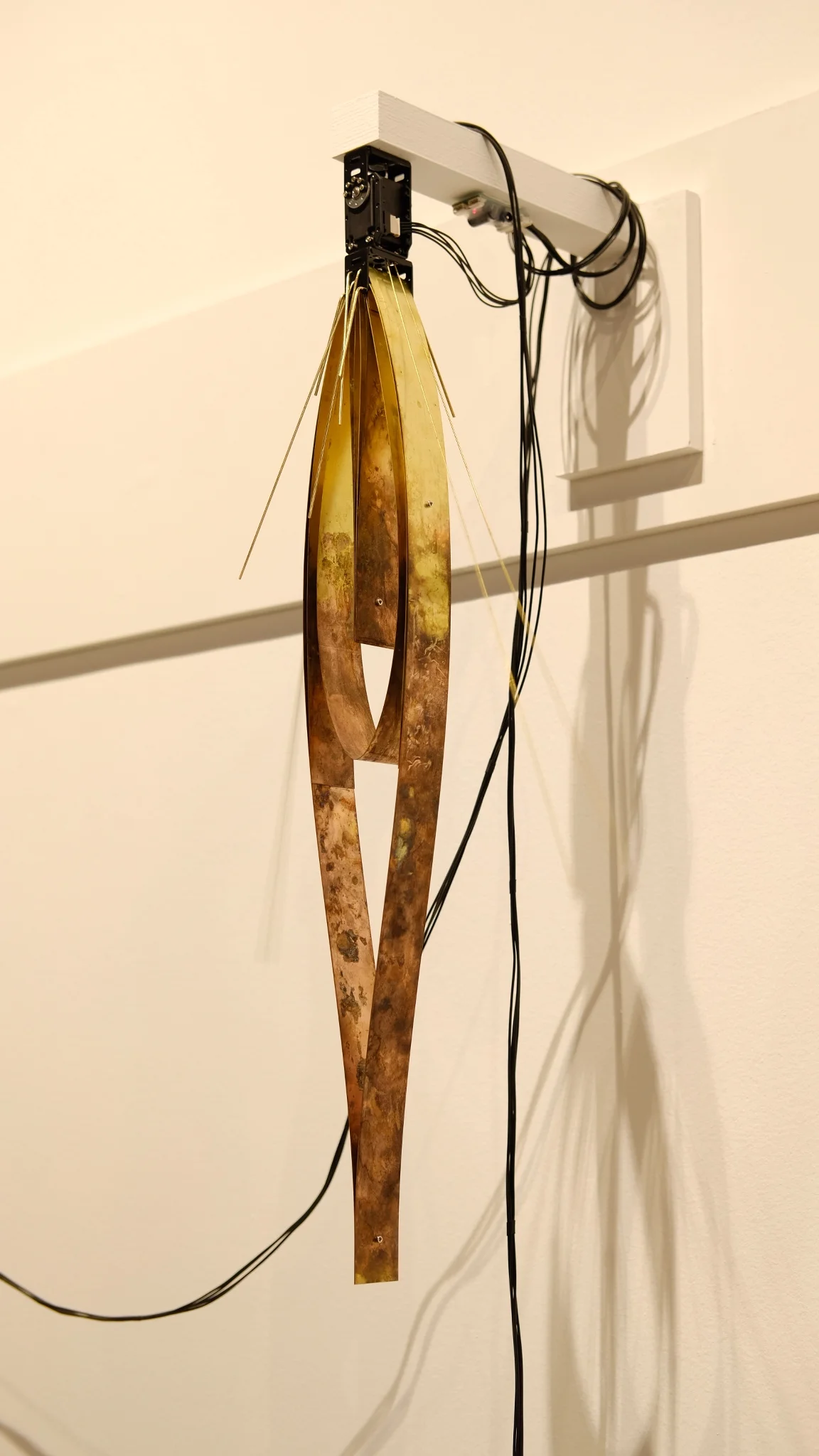
Interactive robotic sculptures, oxidised brass sheets, metallic components and robotic motors.

AL-MARS is a historical timeline plotting the race to colonise Mars against the techno-colonisation of the Arab world. Shono assembles a set of speculative landers, each one marking the date of a Mars mission and its parallel colonial event in the Arab region. The Arab world, in this telling, becomes a Martian surface receiving foreign machines that arrive to establish footholds of influence and power. Each landing carries a reminder of how dependent the region has been on Western technology, and how easily that dependency tips into control.
Unable to build a vessel of his own to reach Mars, Shono instead lets his imagined landers carry him back through the historical events that have already shaped the surface he stands on.
Water for the Traveller
I was younger when the landers first arrived. They ate the earth and drank the rivers dry. I did not see them when they touched the ground, but I heard them when they tore through the sky. My father stood in the field where one did land. He told us stories about that lander late in the night: "It had a tail of fire as it fell to the earth. It planted itself in the soil and unfolded, with its reflective petals chasing the sun."
My father watched the lander as it opened its eyes, spun its neck, and fed from the ground. So he fetched water for the traveller with a pouch my mother had made. Many times I heard him say, "Even a travelling river we offer it water to drink." He placed the pouch at the foot of the lander but its stance did not change. So he poured the water into its mouth until the lander shivered and its skin began to stain. "Rust coloured its mouth and began to spread across its body and limbs. It then became stiff and hulked over before my eyes. I saw it turn to iron dust."
The rust continued to spread. It moved through the trees and across the field. It consumed our home and the homes on the lands that neighboured our own. Even my father, once tall like steel, was consumed with grief until he was rust.
Today I return to a land I do not know. Its soil is red with the rust of the machines that have continued to come, and the rust that has spilled from our veins. I stood where my father once did, with a pouch of water in my fist. I watched the skies and waited for the machines to descend, ready to welcome the thirsty landers again.
The Landers
Five sculptures, each a speculative lander cast in oxidised brass with etched surfaces and robotic motion.
-
![]()
Lander 1971, Mars 2
Soviet Union Parallel event: the construction of the Aswan High Dam, Egypt
-
![]()
Lander 1973, Mars 3
Soviet Union Parallel event: the October War
-
![]()
Lander 1976, Viking 1 & Viking 2
United States Parallel event: the Syrian occupation of Lebanon
-
![]()
Lander 2003, Beagle 2
United Kingdom Parallel event: the invasion of Iraq
-
![]()
Lander 2012, Curiosity (Mars Science Laboratory)
United States Parallel event: the second wave of Egyptian "Arab Spring" protests